Pages

Wednesday, December 12, 2007

Versed in the urban experience

I love my Chicago neighborhood, and have always felt that its many positives far outweigh its unsolved challenges. Living in Rogers Park is an urban experience that won't appeal to everyone, but the natural beauty of the nearby lake shore coupled with a vibrant cultural scene make it a perfect place for me.

Drawn by Lake Michigan's proximity and a still robust affordable housing stock, hard working folks of all ethnicities and incomes make our corner of the city one of the most diverse zip codes in the nation. Unfortunately, due to broader social factors and the city government's too frequent negligence, we also have to struggle with issues of poverty and homelessness.

In an increasingly pay-to-play world, public services are perpetually underfunded, understaffed and under-performing. Our local schools don't offer a good education to those kids whose parents can't afford a private opt-out. Mass transit is being threatened with massive service cuts and fare increases. The county health system is approaching budgetary collapse.

Public safety has devolved into a game of high-tech call and response. Surveillance cameras and sensors are mounted on poles at crime hot-spots to gather evidence more reliably than the human eyes and ears walled in behind brick and mortar facades. Most often, when the cops arrive, whatever was taking place has already moved somewhere else.

Sirens are an all too frequent part of the local soundscape. Thankfully, gunfire isn't as common, but shots still ring out more often than I'd like to admit. Sometimes it's hard for the untrained ear to distinguish real gunfire from more benign disturbances, so you always hope you heard wrong.

When a loud bang rings out, you can only wait for the sirens and pray that another young person hasn't lost their life to senseless street violence. The following poem was inspired by a recent night of such uncertain aural stimulation.

Four Shots
By Francis Scudellari

Four shots, then two, one more
Staccato, rhythmic pops,
Crisp claps, crackling echoes
Shatter the mid-night calm

Staring, brick-walled, I wait
Unsure, probe the silence,
Once serene, sleep-walk made
Too close, seeming fatal

Distant sirens cry out
Infants pulled from sep'rate
Drowsy cribs, converging
Nightmares, now awakened

Imagined violence
Suddenly surreal, first
Arrival announced, screeched
Squad car or ambulance?

Tuesday, December 11, 2007

Fanning a chilled, fevered mind

The cheery carol Winter Wonderland may make a holiday season snowfall seem a blessed event, but that pop-affected attitude loses its charm quite quickly here in the urban American Midwest.

A fresh snow can still be a thing of beauty when rooftops, limbs, and streetlights are first coated in chaste white, but as the days pass and the salt and exhaust go to work, the ground cover changes to a sinfully ugly mix of gray, brown and black slush (and then there's the yellow variety ...).

It marks the onset of that time of year when we Chicagoans contract cabin fever — the restless byproduct of the self-imposed perpetual indoor confinement used to escape the wintry mess. I've already begun avoiding the outdoor chill and have succumbed to navel-gazing, yet another symptom of the seasonal disorder.

It's amazing what entertainments the under-stimulated mind can fashion under such conditions. Here I give you a prime example of too much time spent pondering household objects ... consider it a winter ode to city apartment dwelling.

Five Blades
By Francis Scudellari

Five blades cut, thick air slice sharply
A dark shadowed smudge, whirred voices
Spinning soft tales, currents pushed down,
The day's image blurred, circular
Logic traced on sleep-dusted mind

Five fingers loom, open-palm stretch,
On ceiling spread, stark outlines drawn,
Coldly etched in cloud-dimmed light, rays
Greet up-cast eyes, soul searching, till,
Motion-stopped, energy captured,
Passion starved, I am slapped awake

Monday, December 10, 2007

A poetic voice: Still, small, broken

As Rod Serling used to say when introducing Twilight Zone episodes, submitted for your approval .... another new poem that probably requires no preamble.

A voice broken …
By Francis Scudellari

A voice broken, too brief, cut-off
Before words, sounds can draw me back,
Disembodied calling, reaches
Far from misty-eyed past, beckons,
Takes me mindful aside, adrift
Alone, down wandering, once more
Twisted paths, visited failures,
Fumbled through memories, boxed up

Missing pieces, jagged end scene;
Never wholly answered, accepted,
I silence whispered doubt, inner
Demons pulled close, pushing too
Patient with a present, thought blessed;
Too long waiting for signs, divine
Pointed nowhere, now, here, I risk
Futures decided without me

Ancora una volta, in Italiano

My friend Hanna has done me the honor of translating my recent poem Happy, Happy into Italian, the tongue of my ancestors. She did a wonderful job capturing the spirit of the verse yet giving it a new more musical voice.

It's good to know that the emotion is just as evocative in another language. If you'd like to check it out, the translation with Hanna's eloquent introduction is available on her site:

Amori, poesie, arte, chat virtuali by Hanna

Z: Documenting a political assassination

I've just discovered a DVD that upon first viewing entered my pantheon of favorite flicks. Filmed almost 40 years ago now, Costa Gavras's award-winning thriller Z is essential viewing, with social insights that still resonate. It retells in fictionalized form the story of the 1963 assassination of Greek progressive politician Gregoris Lambrakis.

Tension filled with a camera constantly in motion to capture the sense of an impending explosion, it's a movie fueled by righteous indignation. There are moments of surprising humor as well, and the faux warning at the end of the opening credits gives us a clue to the director's irreverent attitude:

"Any similarity to real life events, persons dead or living, isn't by chance. It's intended."

Z is an exceptional piece of filmmaking that presents its narrative with compelling energy and striking images. In the course of recreating the real life murder, cover-up and investigation, the director intercuts flashbacks that give added insight into the main characters' backstories. The performances are uniformly amazing by actors portraying persons both sympathetic and sinister.

Released in 1969, at a time when the US was experiencing its own bit of military inspired social turbulence, Z went on to become one of the top grossing foreign films in American history. I can well imagine that the political sensibility of its tragic hero, a pacifist senator, hit home with the youth of that period (and still will with our own). His deceptively simple beliefs are amplified through the town square from loud speakers as the players in the murder drama to follow take their places on that stage:
A cannon is fired, and a teacher's monthly salary goes up in smoke. ... Around the world too many soldiers are ready to fire on anything moving toward progress. ... Even imagination is suspect yet it's needed to solve world problems. ... We serve the people and the people need the truth. The truth is the start of powerful, united action.
Why would such sentiments provoke a violent response? Because they represent ideas that threatened the status quo. Greece was fumbling its way toward a modern democracy and the ongoing political struggle challenged the powers that were. More interested in protecting their privilege than safeguarding rights or promoting social progress, the military cracked down on those advocating for such change.

Their tactics may sound eerily similar to those of present day regimes ... local, national and global. Espousing the need to rally behind god and country, they denounced diverse ideologies as bankrupt and politicians as universally corrupt. Claiming a moral superiority informed by their faith, they rejected science and intellectualism. Believing nationalism is the highest good, they renounced all things foreign.

Z is a very artful attempt to shed light on what took place in Greece in 1963. The perpetrators of that crime tried to spin events to exonerate themselves and perpetuate their world view. They recognized the importance of controlling the social narrative, and governments to this day try to manipulate media toward that end. Artists will always play a unique role in countering that misinformation, and that's precisely what this film does.

Unfortunately, even when their lies become transparent, those in power often wield enough judicial levers to shield themselves from punishment. In keeping with that reality, this story doesn't have a very surprising ending. Thanks to Costa Gavras, however, the assassins couldn't escape the damning judgement of public opinion so easily.

Saturday, December 08, 2007

Save the Green Planet: Rescued from an emotional conflict

Sometimes it's exhilarating to throw yourself into an alien environment, not knowing what adventures lie ahead of you or whether you'll escape the experience untouched. So it was when I placed the disc for Save the Green Planet! into the DVD tray and hit play.

The 2003 Korean release struck me as a strange hybrid of varied genres, recalling a mixed bag of movies such as Misery, Silence of the Lambs, The Adventures of Buckaroo Banzai, and the X Files (those of you with deeper film vocabularies will probably find more and wider cultural allusions, especially to non-Western works).

Bouncing between sociopathic horror, psychotic hallucination, intergalactic conspiracy theory, and absurdist comedy, the story is pushed forward at a frenetic pace taking several twisted turns and double backs along the way. I couldn't do the complex narrative justice in such a short review, and the small surprises of many of the details are worth discovering on your own.

In sparest outline, the frame of the story rests on Byung-gu's perhaps quixotic quest to thwart the destruction of Earth fated to arrive with the next lunar eclipse after a torturous 7-day advent. He and his unquestioningly loyal girlfriend Soonyi, an acrobat by trade, kidnap the head of a large chemical company, Kang (a sly reference to the tentacled alien pair from the Simpsons?), who they suspect is part of a mysterious group of extra-terrestrials hiding here in plain sight.

A race against time unfolds from the perspective of three emotionally conflicted parties: the kidnappers, their prisoner, and the detectives trying to track them down. It's a chase that takes place in a murky moral ambiguity. We're never sure who to root for, or against, as heroes and villains, bullies and victims trade places and shift identities.

No one is innocent or free from blame for the crimes personal, social and universal that surface throughout. As the very future of the planet hangs in the balance, we can only hope to grasp a few answers and find a way out of the overwhelming suffering. When it's all over, you may even ask yourself, like Byung-gu, if we're worth the trouble of saving.

A dreamy fish story: hooked by hidden meanings

I'm usually not one to burden others with the task of deciphering my dream meanings, but occasionally I have a sleep-induced imagining that seems too deceptively random to take at face value. The best fairy tales can be read as simple adventures on the surface, but swimming beyond the shallows we often discover darker psychological metaphors swirling in their murky depths.

I dream a lot each night, and the topics shift quickly to include new objects and places; each flowing from a previous mental scene with completely different actors. The new imagery starts midstream and continues until another idea overtakes it, or waking rays of morning wipe it out. The abrupt changes in perspective and narrative might seem jolting in real life, but are completely consistent within my land of nod.

So this one begins with a sudden but accepted transition. I stand before an empty aquarium with its light bulb strangely detached from the lid. It's an average sized tank ... the 10- or 20-gallon variety found in most homes. The unlit bulb hangs awkwardly in the clear water, calling out for assistance to my perpetual desire to put things right.

I assume that it's my fish tank, although I haven't actually ever owned one. It seems oddly still, as if there ought to be fish inside, but I stick my hands in anyway. I do my best to snap the bulb back into place and put the lid back on. That's when the strangeness begins. As if tainted by my touch, the water begins to change to a milky white, and I realize that this isn't my aquarium at all.

It seems I've been playing in an alternate world, and forgot to switch back to my own dimension. The tank in fact belongs to someone else; one of the avatar-linked members of a virtual community to which I belong. I "log off" and return to my reality quickly, worried that I might have caused irreparable harm to his fish tank, wondering if he left the water uninhabited for a reason, perhaps to clean it or treat it.

The tank then changes to one that I accept as my own. It's fully decorated and some fish swim around in its bubbling water, but not all that belong there. There's a shallow, clear tray sitting in front of it, and a number of my fish have been placed in this temporary home. I sense that this may be the pay back for my well-intentioned virtual vandalism.

The tropical fish of many colors and shapes teem in the tray, swimming with difficulty. Some are too big for the amount of water there, so they flap their fins while floating on their sides trying to remain submerged. Feeling an urgency to get them back in the bigger tank, I lift the tray and try to pour the fish out slowly. The first to reach the aquarium — a large, plump, orange goldfish — passes right through the water and lands convulsively on the floor.

The tank, I then realize, isn't actually there after all, having been replaced by a realistic simulation. I second guess myself for not having kept the aquarium off-limits to other's manipulation (the way objects work in Second Life, for example). I feel a sudden panic about the well-being of the rest of my fish, and then I wake up.

Note: Image courtesy of Lerdsuwa at WikiMedia. Click here to see a larger version with full description.

Friendships virtual but very real

I recall much hand wringing in certain circles when social networking first started to take hold. The blossoming of virtual communities, the thinking went, would foster increased isolation and withdrawal from real world interactions.

I've always taken a different, more hopeful view of the phenomenon — believing that extending our connections can only help to expand our perspective and improve our outlook. As important as it is to maintain and nurture our ties to friends, family and partners physically close to us, it's equally rewarding to discover kinships that reach around the world, beyond the limits of our perceptual borders.

So it was that I fearlessly leaped into the new paradigm with both feet. The first step was to begin this little blogging experiment I've titled Caught in the Stream. The second, equally significant, was to explore the many faceted imaginings of the greater blogosphere through community-building sites such as My Blog Log and Blog Catalog.

Along the way I've met dozens of diversely creative, interesting, insightful, generous and supportive bloggers who have helped me to broaden my mind and deepen my spirit. Two of my dearest virtual friends have double tagged me with another honor — bestowing on me a new badge in recognition of our mutual esteem: The Colors of Friendship award.

Deborah at Climate of Future is always quick to acknowledge my kindness, and she's been equally ready to help me every way she can while indefatigably building awareness about global warming. Michelle at Binding Ink never spares a supportive word for my writing and uses her special ink to knit together more tightly our community of writers.

Now I have the hard task of singling out just five bloggers who have taught me valuable lessons about this very real new kind of friendship. They have wide networks of admirers and may have already received this award from one of them, but I'm giving each a shout-out nonetheless:

Friday, December 07, 2007

A wintry instrument played


There's something about this time of year that brings out the poetic in me. It's probably too much time alone; walled in to stay out of the frigid outer elements. The world blanketed in white doesn't interest me as much, so I retreat into my mental den and explore the more colorful recesses of my imagination.

This is a poem that was inspired by an actual dream I had several years back. I think it touches on the time-worn urge of all story tellers to communicate something within themselves to the outside world — be it an experience, mood or sentiment. Sometimes our moments to shine forth are brief, so we need to make the most of them.

I'll be back to my more prosaic musings shortly ... so don't tune me out just yet.

Hollow Reed
By Francis Scudellari

Before me, it floated;
An instrument, unknown …
Not flute, nor horn, but reed
Of sorts, perhaps, or not;

Plated, gold, its metal
Thin, delicately stretched;
Mouthpiece of hammered face,
Regal, familiar, mine …

Features older, wiser;
I sensed it waited, long
Expected, my breathed wind;
On dreamed steps, I approached;

Fearful, hands shaking, held,
Hesitated, seconds;
Thoughts sensing, knowing, it
Seized doubt's moment, read me …

Reached into my lungs, pulled
Out, my soul, billowing
Fog, poured from hollow pipe,
Sounding ten, twelve sharp notes …

Rising up, freed, it climbs,
Dissipates, with others,
Cloud-carried, unfinished
Songs, short, sad melodies.

Thursday, December 06, 2007

Spreading sweetness and light, for now

Never one to renege on a promise, I'm posting yet another verse but this one with a much happier tone. Of course, it wouldn't be one of mine if the the brightness wasn't tinged with a bit of sadness by the time it meets its end.

It's a bit oddly structured as well, with a bit of verbal contradiction to undermine the seeming simplicity. I don't know if any of what I just said will make much sense, but it's late and my mind is traveling along some twisted paths lately.

Happy Happy
By Francis Scudellari

"Happy, Happy, Happy!" sings out,
In joy, my time-tossed soul,
A shimm'ring light bathes all, I see
Here in glowing warmth, born
On soft breezes, voices airy,
Earth-wide whispers: pure bliss
Many colored, glitt'ring pieces,
Holy charms calm my mind
My heart free, child-like, innocent,
Wise to giddy excess,
Revels in each moment, fleeting,
Fixed, 'fore darkness returns

Tuesday, December 04, 2007

They call it Stormy Monday, but Tuesday's just as bad

Continuing my recent poetic streak, I'm offering up a reworked mood piece. It's the polar opposite of yesterday's verse, burning brightly, though a bit too hot, to cancel out that shadowed darkness.

I've long recognized within myself a propensity to rail against the world when I'm feeling emotionally fragile. With very little provocation, in circumstances that may seem unusually mundane to the outsider, an anger flares up that verbally scorches all in its path. At those times it's best to let the fire rage on at full intensity until it exhausts itself and is replaced by a seeming serenity.

Maybe tomorrow I'll post a happy piece ...

Rage Inferno
by Francis Scudellari

Rage inferno, out leap
Long smoldering, fed on
Indignation's kindling
Unkind, burn, flame lost lust
Unequaled, encompass
All in fiery wrath,
Engulf hopes, on-fanned fears
Unashamed, singe sins now
Unrestrained, not put out
By discretion's thick cloak,
Nor Reason's cool water,
Spread fast, flatly consume
Even yourself, leave me
Nothing bitter, sweet ash

Blow tempest, bluster on
Whipped waves, fierce frenzy-fed
Malevolence, batter
Uncaring, all, your path
Indiscrim'nant, o'erwhelmed,
Unleash havoc, away
Wash the memories, purge
Transgressions, loose, topple
Barricades, thoughts ravage,
My senses inundate,
Until, stripped bare, naked,
Calmed soul, numb, beaten I
Am left alone, utter
Cursed words, yet wholly, saved

Monday, December 03, 2007

A winter chill that blows into every life

Today marks a very difficult anniversary for me and my family. It's the day we kids lost our compass and my mother lost the love of her life. Almost twenty years on now, I'm still making my peace with the sense of spiritual drift that followed.

My father isn't physically here any more to keep me on the right path, and I'm not sure that he'd approve of many of the choices I've made in this life. He does still inhabit my dreams and memory, however, and I try to believe that his spirit guides me in its own way from afar.

I wrote the following poem much later. It wasn't in response to his specific death, but a series of funerals that played out over too short a time thereafter. Sometimes our holidays are taken from us unexpectedly, and we're forced to separate ourselves from the general jubilation and reflect on realities tough to face at any time of year.

I'm sorry it's not very cheery seasonal fare, but I'll be back to my spirited self in the days to come. In the mean time, grant me this indulgence to honor my father, his life and his death.

Poor Jon
by Francis C. Scudellari

"Poor Jon," false, fed, falls.
"Dear man," trite, trim, trickles.
"Dear Jon," pathetic, pours.
Pours down ... down ... down into

The outstretched palms;
The stiffened arms
draped in once-worn wool;
An ill-fitted suit.

A mumbled man;
a whispered woman;
a chided child—
Each future glimpsing shades
in the past reflected pool—
Pause by ... nod to ... turn from

The powdered head;
The cracked pale skin;
The straying hair;
The fire doused eyes.

His cat'ract sight blinded,
Jon no longer to search hollows
of a time-tricked, thread-bare mind,
driven by fickle winds, flitting visions
to roam longing lost shores,
to wade through ebbing dreams.

His crooked corpse numbed,
Jon's withered arms no more to reach;
the Christ crossed legs to step;
the age arched trunk to bend
toward the milk lade earth,
the mother clay it craved.

His buried soul freed,
Jon's arked covenant lost,
not in long labored flight to Remember,
but in the rested peace of Forget.

"Poor, poor Jon."
His wince answers the toothless smile.
"Poor Father."
She fingers closed the deep set eyes.
"Poor Grampa."
She places petals in cold hands.

Darkened, dear drops
Water-severed flowers mocking
Feed the black stream buoying
A weathered shell embarked toward dust.

Creating something out of nothing

Sometimes the fates conspire to rob us of our substance. Our day is wrapped in a big blanket of blah and the creative fires fail to spark in the suffocating stillness. It's a misty eyed morning moment that tempts us to pull the covers over the head and give in to the urge to hibernate through the winter drear.

Never one to succumb to such inclinations toward self-indulgent idleness without at least a token fight, I'll grasp my virtual pen more tightly and force the inky blood to spout from its stubborn mouth until it decorates this blank page with my purple prose.

Lacking anything insightful or interesting to say about the events transpiring beyond my warped walls, I have to sculpt instead the form of an idea from the globbed clay that's mucking up my imagination; take the randomly spinning impulses and shape them into a well-fired thought. Nothingness is not necessarily a precursor to meaninglessness, if we use it as the premeditative abyss out of which creation can spring forth.

Over the wisdom giving years, I've slowly come to realize that I can't tackle everything on my own. Sometimes, for a moment, I have to give up trying to change the world and let it change me, and my mood. So it is that I searched the depths of my soulful music collection to discover a nothing-themed nugget by Badly Drawn Boy that I hope will draw me out of my doldrums.

Here is the video, and below that are the song's lyrics in case you want to sing along with me.

Nothing's Gonna Change Your Mind
by Badly Drawn Boy

this would be easier if you'd understand
face the truth and realise
that none of this was planned
the way we worry about such little things
take the time to take the break
and darling spread your wings
I stole all the roses that make your crown
now it's easier to just put aside
the things that face us now

strange when something
comes from nothing
came around to your way of thinking
about these things
saw your face in a crowd
I knew that you were special
and it would change my world
if I could help you now

but nothing's gonna change your mind
and no one's gonna help you now
if nothing's gonna change your mind
no one's gonna help you find
your place in this world
so strange, lean on me — I'll help you now

Well let's dance to the beat of the drum
Let's go out where we don't know anyone
'Cause it's you, I don't need anyone else
I've got you, don't need anyone else
But
You (and no one could ask for more)

Well, you know where you will find me
In a time and a place
Where the world doesn't seem so strange
I'd like to think there's a chance
Just knowing that I love you
You would feel that would be enough
To make you change

Saturday, December 01, 2007

Things you see looking up, a new poem

This is a poem I wrote over the past few days, having twice seen condensation trails bisecting the afternoon sky. I presume they were left by aircraft, but I saw no other trace of whatever created them.

Stepping through my daily routine, I looked up to see the fuzzy white lines that reached from horizon to horizon as far as my eyes could peer. Studying them proved a nice diversion as I paced my way through the chill Chicago air, anticipating the start of another winter.

That was enough stimulus to provoke pondering of the usual unanswerables and to inspire the following verse.

Follow Anew, Trail
By Francis Scudellari

Pressed by, the daze, errand
Footfalls thudding, lost, in
Thoughts chilled, self searching, I
Look up at winter's sky

Vapor arcing, spreading
Starkly, thin essence writ,
Authorless acts told, once
Of unclear beginnings

A worn white scar traced
With traveling fingers
Scratched, across pale blue sky,
Wounds, unknown, left behind

A jagged edged tear, now
Closed up, today, stitched new,
Hid heavens, dark secrets
Whispered low, long ago

Seeming without end,
Spilling forward, in time
It fades back to stretched mist,
Reseeds a cloudless haze

To emptiness, returned,
Head lowered, I, push on
Blank steps, follow anew,
Trail, my line imagined

Friday, November 30, 2007

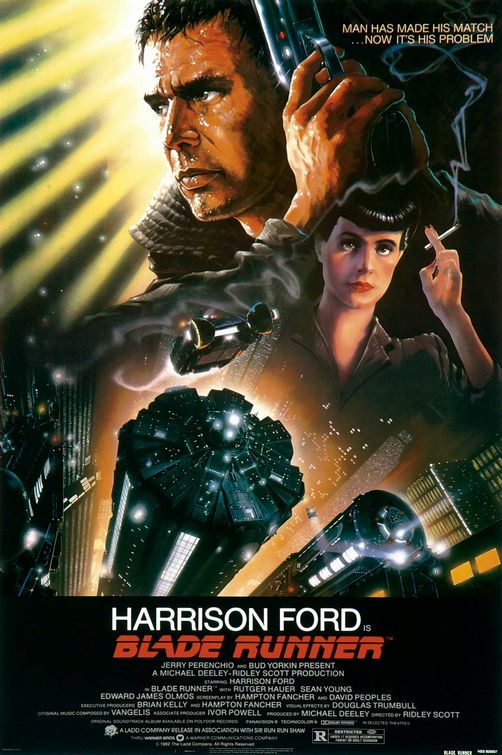
Ridley Scott's Blade Runner: Death of an android, birth of a man

Today is film director Ridley Scott's 70th birthday, and to commemorate the occasion I'm sharing my favorite scene from the work to which he'll always be most closely linked in my mind. Blade Runner, Scott's adaptation of Philip K Dick's Do Androids Dream of Electric Sheep?, was released 25 years ago and has stood the test of time as one of the most visually artful examples of science fiction movie making.

Scott has directed some other pretty popular theatrics, including the recent blockbuster American Gangster and the 2000 Best Picture Academy Award Winner Gladiator, but none have left as strong an impression on me as this futuristic film noir about a detective investigating what it means to be human. It's a question that will take on increasing relevance with each inevitable advance in the sciences of Robotics and Artificial Intelligence.

There are many amazing images to recollect from the moody movie, but I've always found most compelling the climactic shot. A shocked Deckard, beaten down from his chase after a rampaging replicant, is a captive audience to the twist ending of a sentimental Roy Batty's dying words. The dove symbolism might be a bit too obvious, but the thoughts capture the romantic soul of a storyteller wishing to share the beauty of personal experience, and it frames well the dubious morality of Deckard's own quest.

The film is a dark imagining of a future dominated by technology; where those seeking freedom and humanity are deemed both threatening and criminal. It casts a surprisingly philosophical focus on the moral choices we make when faced with our own mortality. Humans and androids of the world unite, you have nothing to lose but your virtual chains.

Another planet: Looking at twin possibilites, and more

I always find myself gravitating toward the latest astronomical stories, so it came as no surprise that I was drawn in to yesterday's pronouncement by scientists that Venus and our home world have a special relationship (see New Findings Underscore an Earth-Venus Kinship from the New York Times).

The European Space Agency used the analogy of "twins separated at birth" to grab headlines for the conclusions taken from their Venus Express spacecraft's data transmissions. The two planets share a similar size and composition, but Venus has surface temperatures in excess of 800°F and a dense atmosphere made up of carbon dioxide.

Venus once had Earth-like oceans, but the water evaporated in the Sun's intense heat and the resulting greenhouse-gas effect trapped more heat creating a feedback loop that generated the planet's current smog-like cloud cover. If our current carbon emissions continue unabated, the Earth may find itself spinning toward a similarly hazy future.

The Euro-scientists' twin reference is an interesting one and hearkens me back to the countless science-fiction renderings of parallel universes and through-the-looking-glass scenarios. As a kid, I watched a TV movie about an astronaut who when shot into space discovered a mirror Earth on the opposite side of the Sun. The prospect of such a duplicate world captivated my young imagination, offering a vague sense of heavenly second chances.

Of course why stop at two alternatives when there's a quantum theory full of broader probabilities. I'm fond of poetically conjuring the possibility of simultaneously occurring realities; a universe where all potential outcomes exist at once. It may seem a silly fantasy, but it's much easier to accept failure if there's another me or we who can get it right in the end.

Another Girl, Another Planet
by The Only Ones

I always flirt with death
I look ill, but I don't care about it
I can face your threats
And stand up straight and tall and shout about it

I think I'm on another world with you, with you
I'm on another planet with you, with you

You get under my skin
I don't find it irritating
You always play to win
but I won't need rehabilitating

I think I'm on another world with you, with you
I'm on another planet with you, with you
Another girl, another planet

Space travel's in my blood
There ain't nothing I can do about it
Long journeys wear me out
But I know I can't live without it

I think I'm on another world with you, with you
I'm on another planet with you, with you
Another girl is loving you now
Another planet is holding us down
Another planet

(Click here to see a video of the song)

Thursday, November 29, 2007

Meming to catch up ... read at your own risk

I've been tagged and honored a few times in the past week, so I'm going to cheat a bit and combine my thanks and obligations in one unruly post ...

First in my list of to-do's is a public debt of gratitude to pay out to my dear friend Bola at MumsDadsChildren who kindly passed on to me the Nice Matters Award. It's the second time I've been given this particularly generous consideration, so I am twice-blessed — thanks Bola.


Next, I need to recognize a dual tag from Nick at Personal Paranoia and Raven at Stuperhero Extraordinaire who both selected me as their victim in the perpetuation of a fun meme that lets me discover how much (or little) I share in the personality traits of my fellow Decemberists.

In brief, I'm obligated to paste a paragraph of qualities pertaining to those born in my birth month and highlight the ones that apply to me. There are some other duties outlined in the official rules, but I'm a natural iconoclast (that's not listed below, alas) so I'm dispensing with most of them at the risk of incurring some bad broken-chain-letter type of Karma.
DECEMBER: Loyal and generous. Sexy. Patriotic. Active in games and interactions. Impatient and hasty. Ambitious. Influential in organizations. Fun to be with. Loves to socialize. Loves praises. Loves attention. Loves to be loved. Honest and trustworthy. Not pretending. Short tempered. Changing personality. Not egotistic. Take high pride in oneself. Hates restrictions. Loves to joke. Good sense of humor. Logical.
I'm not particularly fond of self-analysis, but there it is. For this meme and the next (stay tuned), I'm skipping the step of singling out fellow bloggers and tagging anyone who reads this and is excited to participate. For all you meme geeks out there ... have at it.


Last, and certainly not least, I have to acknowledge my selection for the 7 Weird or Random Facts meme by Deborah, my irrepressibly wonderful colleague at Climate of Our Future. As you might guess from the name, I need to continue the trend of self-revelation and identify some personal strangeness. I'm pretty good at that, especially when I get to have at randomness as well, so here are my bulleted points:
  • I love grilled onions, but can't stand raw ones (that goes for roasted/raw garlic as well).
  • I have never seen the movie ET, and never plan to, but for no particular reason.
  • I once killed a man for laughing at me ... wait, that was someone else. I once got very angry at a man for laughing at me.
  • I have never been in the state of Texas.
  • Both of my parents were born in New York.
  • I don't like wearing hats.
  • I don't like being cold, yet I often underdress for the weather (see point six).

Wednesday, November 28, 2007

Raising spirits for William Blake

Completing the second half of my November 28th birthday tributes, I honor the life and work of William Blake, the poet and visual artist who was born a numerically significant quarter-millennium ago on this date.

William Blake was a man of many seeming contrasts, and as such an inspiration for fulfilling my own contradictory impulses. He created works of deep spirituality, but he also concerned himself with the very material people and events of his time and place. He bristled at organized religion, but was also a mystic who had visions of angels and the ghosts of Old Testament prophets. He was considered mad in his own time, but won countless admirers among the creative generations who followed in his footsteps.

Although he was a devotee of the metaphysical and an inventor of his own mythologies, Blake also delved into the political and social issues of his day. He wrote in praise of the American and French revolutions, and he documented the human abuses that took place in the early English Industrial Age.

The weak and innocent didn't fare well in the brutish early period of Industry's growth. The mistreatment of the young boys who were conscripted to sweep the soot from London's flues and chimneys was certainly one glaring example of that. In two companion pieces from the volumes Songs of Innocence and Songs of Experience, Blake lamented the sad fate of these young men who were sold into the dark service by their impoverished parents.

I've included the Experience poem below (an image of Blake's original artwork and verse appears above). You can click here to read the full text of the other, more innocent "Chimney Sweeper." The two pieces provide a good taste of the dualities in Blake's creation.

Songs of Experience: The Chimney Sweeper

A little black thing among the snow,
Crying "'weep! 'weep!" in notes of woe!
"Where are thy father and mother, say?"
"They are both gone up to the church to pray.

"Because I was happy upon the heath,
And smiled among the winter’s snow,
They clothed me in the clothes of death,
And taught me to sing the notes of woe.

"And because I am happy and dance and sing,
They think they have done me no injury,
And are gone to praise God and his Priest and King,
Who make up a heaven of our misery."

Author: William Blake
Online Poetry at PoetryFeast.com

Appreciating the caustic wit of Randy Newman

In the first of two very different November 28th birthday tributes, I offer a tip of the hat to singer, songwriter, and film score composer Randy Newman. I've always appreciated the biting sarcasm of Mr. Newman's lyrics, and his 1972 album "Sail Away" ranks among my all-time favorites.

I've referenced two songs from the record in previous posts (see Praying for rain and other idol pursuits and Let's drop the big one now), and below I present a video clip of his live performance of the title track. It's a typically twisted narrative take on a glossed over view of the legacy of American slavery.

Having spent his formative years in the two LA's (Los Angeles and Louisiana), Mr. Newman definitely has a unique perspective on our national identity. It's a compelling contradiction of love-hate that openly embraces small town generosity while pushing away the bigotry and closed mindedness.

Tuesday, November 27, 2007

Beowulf: Fleshing out a hero

The new movie treatment of the Old English epic Beowulf is a superficially interesting but ultimately flawed creation, just like the hero whose exploits it portrays. The retelling is very modern in its sensibilities and techniques, but it can't quite capture the magic of the source verse. It tries to flesh out the man behind the ancient warrior, but lacks the warmth and insight to add depth to its special-effected vision.

The major selling point for the film is that it's the latest generation of 3D technology shot using performance-capture-suited, big-name stars. Unfortunately the theater near me wasn't equipped to show it that way, so I didn't get to experience the movie as the director intended. I've read that the switch to digital projection is becoming more economical, but in the big city of Chicago a large majority of theater owners still haven't done so.

In 2D, the movie's visuals aren't strong enough to counteract the sophomoric humor and sight gags into which its story occasionally devolves. The screenwriters do attempt a post-modern spin on the hero's legend, but the ideas aren't weighty enough to lend it real heft. The animation in fact robs most characters of their humanity, reducing them to smoothed over, plastic action figures. In many ways, Grendel, Beowulf's troll-like first foe, has more physical and emotional depth than any of the leads.

One of the film's major themes is the disparity between myth and reality, and how the power of legend often trumps the need for truth. That's not a new idea, but it is a clever justification for the writers' twist on the traditional telling of Beowulf's story. They undermine the glory of his youthful acts in order to endow his final self-sacrifice with more meaning. Given the span of time the action skips over in the interim, it's hard for the audience to buy into that spiritual growth.

An interesting subtext is the tension between Pagan and Christian beliefs that bleeds through from the original epic poem. Beowulf is a pre-Christian Germanic tale that was passed down orally among the Anglo Saxons before being codified in written form with religious embellishment, perhaps by an 8th century monk. The film's grayed and weary Beowulf laments the lapsing of the age of heroes to a time dominated by martyrs. Ironically, at story's end he seems to embrace the very role he deemed shameful, as the distinction between martyr and hero becomes blurred.

The film isn't the most thoughtful meditation on the nature of heroism, but it should bring renewed attention to an important piece of our literary heritage, and that's a good thing. The Answers.com article on Beowulf has a nice summary of the original plot and great background information, including several external links to the full verse.