Pages

Showing posts with label Philip K. Dick. Show all posts

Friday, November 30, 2007

Ridley Scott's Blade Runner: Death of an android, birth of a man

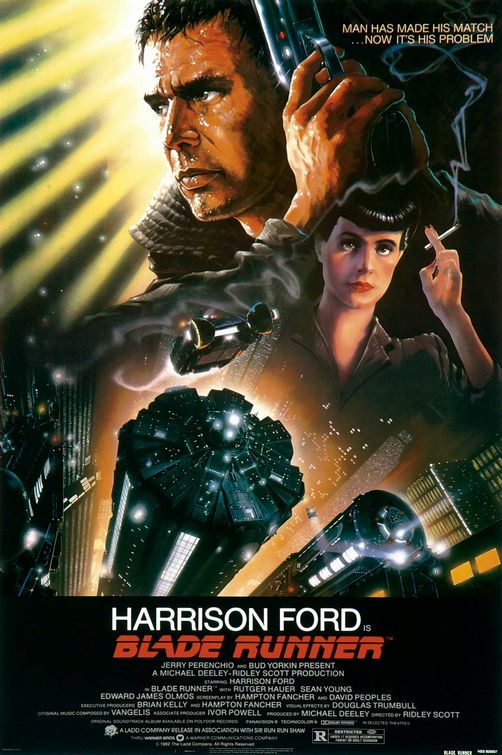
Today is film director Ridley Scott's 70th birthday, and to commemorate the occasion I'm sharing my favorite scene from the work to which he'll always be most closely linked in my mind. Blade Runner, Scott's adaptation of Philip K Dick's Do Androids Dream of Electric Sheep?, was released 25 years ago and has stood the test of time as one of the most visually artful examples of science fiction movie making.

Scott has directed some other pretty popular theatrics, including the recent blockbuster American Gangster and the 2000 Best Picture Academy Award Winner Gladiator, but none have left as strong an impression on me as this futuristic film noir about a detective investigating what it means to be human. It's a question that will take on increasing relevance with each inevitable advance in the sciences of Robotics and Artificial Intelligence.

There are many amazing images to recollect from the moody movie, but I've always found most compelling the climactic shot. A shocked Deckard, beaten down from his chase after a rampaging replicant, is a captive audience to the twist ending of a sentimental Roy Batty's dying words. The dove symbolism might be a bit too obvious, but the thoughts capture the romantic soul of a storyteller wishing to share the beauty of personal experience, and it frames well the dubious morality of Deckard's own quest.

The film is a dark imagining of a future dominated by technology; where those seeking freedom and humanity are deemed both threatening and criminal. It casts a surprisingly philosophical focus on the moral choices we make when faced with our own mortality. Humans and androids of the world unite, you have nothing to lose but your virtual chains.

Monday, June 04, 2007

A Scanner Darkly: Animating Philip K. Dick

My latest tardy 2006 film viewing was of Richard Linklater's A Scanner Darkly. I liked the film, but mostly because of the Philip K. Dick story that inspired it (see a pretty nice write-up of the novel on Wikipedia).

Linklater uses the same "rotoscoping" animation technique as his earlier film Waking Life, which gives Scanner an appropriate surrealistic quality but the look isn't quite as fresh or impressive the second time around.

The story takes place in Orange County, California seven years into our future (it was more distant for Dick, who wrote his novel in the 70s), and none of it seems farfetched. About the only technology alien to our own time is the "scramble" suit used by the narcs to hide their identities.

The government is waging a war on drugs both abroad and at home, and the country has sacrificed its freedoms to those pursuits. With the help of cameras and scanners, undercover agents monitor everyone, including themselves, trying to sniff out the suppliers of a new, highly addictive drug called "Substance D." Some of those agents, as well as the conspiracy-minded addicts, suspect the complicity of a shadowy corporation called New Path that operates a franchise of drug rehab centers in a sweetheart deal with the government.

The main character is a narc code-named Fred (played by Keanu Reeves), who loses himself to his role as Bob Arctor, gradually suffering the trademark psychosis of Substance D addiction. As his mind falls apart, he tries to recover and understand his true identity, and it's that struggle for self that the novel's title speaks to. Frustrated that he's only able to get a murky glimpse of himself, Fred hopes the scanners contstantly studying him have a clearer view and can make better sense of who he is.

It's an interesting concept, especially in a society where we too find ourselves constantly being watched. As the network of cameras, sensors and computers gets extended, we are constructing an artificial intelligence with a god-like, omnipotent reach. Maybe under that unblinking, ever-watching entity's gaze, we will gain a better understanding of ourselves than we could ever achieve from limited individual perspectives. Of course that assumes those running the network have our best interest at heart, and that may be the most fantastic proposition of all.