It's not that rocks don't
Feel. Keep still your eyes, look. See
Our shy smiles shimmer
Showing posts with label Birthday. Show all posts
Showing posts with label Birthday. Show all posts
Monday, December 20, 2010

Friday, December 19, 2008
Buon compleanno a me: another year in the books
Tomorrow marks the completion of my 45th year breathing this atmosphere. I have every expectation that my 46th ride along the earth's regular solar revolution won't be dull, and if the universe decides to smile (or frown), it may even be fate-full.
I have a strong hope that circumstances — personal and global — are flowing together in such a way to propel me in a new direction (physically, mentally and spiritually), but then again, I thought the lottery was a sure thing the other day.
Sunday, January 20, 2008
Taking a queue from Fellini
 As we're all needing a break from my possibly over-indulgent Winter descent into navel gazing, the calendar offers me a double opportunity to mark the birthday of film great Federico Fellini and to engage in some cathartic song and dance. (Image at left adapted from a photo taken in 1965 by Walter Albertin, New York World Telegram staff photographer)
I've always been fond of Fellini's work and, as coincidence would have it, my very first post on this blog was a review of La Dolce Vita. As my 2008 tribute to this maestro di cinema, I present the final scene from Fellini's 8 1/2.
It's one of my favorite film endings, and how I think we should all conclude our life's work. Line up all those who have touched us for good or ill, cue the band, crack the whip and make the memories dance in a wonderful flourish of circus-like showmanship. The fabulous Nino Rota provides the score, as always, and it's a finale that will bring a smile to your face whether you've seen the film or not.
Thursday, December 20, 2007
Finding the special in a non-descript day
 December 20th is not a date on which much of any real import has happened.
A day before the solstice, five days out from Christmas, and 11 back from year's end, the world just wants to catch its breath before the big rush of excitement.
Here is a minor historical accounting of the date's sometimes trivial past happenings:
- In 1803, the U.S. completed its biggest single land grab as Thomas Jefferson purchased the Louisiana Territory from France.
- In 1860, the state of South Carolina became the first to secede from the union and kick started a process that would inevitably tear the expanding country apart. From bad to good, the resulting internal revolution created the opportunity to undo one of our Constitution's worst oversights.
- In 1946, there were two theatrical birthings. It's a Wonderful Life, Frank Capra's now-overplayed Christmas classic about pondered suicide and redemption, took its first bow in New York City. Half a world away in Israel, Uri Geller, the pseudo psychic with a penchant for bending spoons and re-invigorating clocks with his energetic touch, screamed his way onto the stage.
- In 1963, on a snowy morning, Francis Christopher Scudellari (pictured above) was spanked to breath by the medical staff at Providence Hospital in Washington DC. He was the third of four children born to Marina and Anthony. From there the picture gets fuzzy and indistinct. Many guises put on, but none yet to stick. Check this space regularly for updates.
Looking back mid-journey

In anticipation of tomorrow's very special anniversary (stay tuned), I've written the following new poem.
Whenever you reach the midpoint of a journey, it's good to take a moment's pause and reflect. Looking back, you may realize you've meandered off the chosen path, but there's still time for a course correction.
I know that I often live up to the stereotype of a man reluctant to ask directions, but I'm doing my best to change that.
Feel free to map things out for me when I go astray.
At midpoint journeys paused
By Francis Scudellari
At midpoint journeys paused, pondered
Outward roads radiating, spun
Dizzy with destined choices, made
Unsure, unbalanced, reluctant
To stop, self-centered missed steps posed,
Halted remorse wanting to run
All directions, at once, up-down
Disorient, past-visions blur
In momentary forgetting,
Lose untracked paths original,
Sins cast off, memories shred, gilt
Edged possibility rebirth
A way randomly picked, still hope,
Time, tried decisions undo, trails
Again retrace, lines draw forward
To points new, endings yet unknown
Sunday, December 16, 2007
Arthur C Clarke: Starting the Odyssey toward AI
Arthur C. Clarke, the novelist and screenwriter of my favorite science fiction film, turns 90 today, December 16th. In combination with Stanley Kubrick's amazing visual sense, Clarke's 2001: A Space Odyssey becomes a poetic future-dream envisioning artificial intelligence run amok in a space-bound journey to discover the nature of God and humanity.
For me, the film's most intriguing character by far is the HAL 9000 computer that malfunctions and nearly jeopardizes the mission to Jupiter, where a crew is being sent to solve the divine riddle of the monolithic black slab that has spurred human evolution across the ages.
Dave Bowman, the astronaut who earlier had befriended this AI caretaker, is forced to unplug HAL in order to continue the strange odyssey that ends with an intriguingly abstract contemplation on time and space.
Here is the very tense scene where HAL meets his maker. The computer's ruthless bent toward self-preservation, followed by denial, false contrition, bargaining and existential angst betrays a range of human emotions that rivals the spacemen it's his charge to keep alive. It's scary, sad and a very compelling piece of movie making culminating in HAL's haunting refrain as his mind slips away: "I can feel it. I can feel it. I can feel it. I'm afraid."
For me, the film's most intriguing character by far is the HAL 9000 computer that malfunctions and nearly jeopardizes the mission to Jupiter, where a crew is being sent to solve the divine riddle of the monolithic black slab that has spurred human evolution across the ages.
Dave Bowman, the astronaut who earlier had befriended this AI caretaker, is forced to unplug HAL in order to continue the strange odyssey that ends with an intriguingly abstract contemplation on time and space.
Here is the very tense scene where HAL meets his maker. The computer's ruthless bent toward self-preservation, followed by denial, false contrition, bargaining and existential angst betrays a range of human emotions that rivals the spacemen it's his charge to keep alive. It's scary, sad and a very compelling piece of movie making culminating in HAL's haunting refrain as his mind slips away: "I can feel it. I can feel it. I can feel it. I'm afraid."
Friday, November 30, 2007
Ridley Scott's Blade Runner: Death of an android, birth of a man
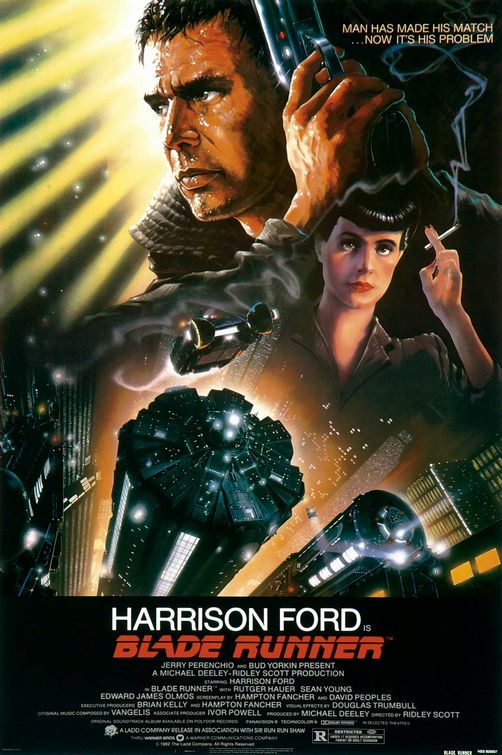 Today is film director Ridley Scott's 70th birthday, and to commemorate the occasion I'm sharing my favorite scene from the work to which he'll always be most closely linked in my mind. Blade Runner, Scott's adaptation of Philip K Dick's Do Androids Dream of Electric Sheep?, was released 25 years ago and has stood the test of time as one of the most visually artful examples of science fiction movie making.
Scott has directed some other pretty popular theatrics, including the recent blockbuster American Gangster and the 2000 Best Picture Academy Award Winner Gladiator, but none have left as strong an impression on me as this futuristic film noir about a detective investigating what it means to be human. It's a question that will take on increasing relevance with each inevitable advance in the sciences of Robotics and Artificial Intelligence.
There are many amazing images to recollect from the moody movie, but I've always found most compelling the climactic shot. A shocked Deckard, beaten down from his chase after a rampaging replicant, is a captive audience to the twist ending of a sentimental Roy Batty's dying words. The dove symbolism might be a bit too obvious, but the thoughts capture the romantic soul of a storyteller wishing to share the beauty of personal experience, and it frames well the dubious morality of Deckard's own quest.
The film is a dark imagining of a future dominated by technology; where those seeking freedom and humanity are deemed both threatening and criminal. It casts a surprisingly philosophical focus on the moral choices we make when faced with our own mortality. Humans and androids of the world unite, you have nothing to lose but your virtual chains.
Wednesday, November 28, 2007
Raising spirits for William Blake
.jpg) Completing the second half of my November 28th birthday tributes, I honor the life and work of William Blake, the poet and visual artist who was born a numerically significant quarter-millennium ago on this date.
Completing the second half of my November 28th birthday tributes, I honor the life and work of William Blake, the poet and visual artist who was born a numerically significant quarter-millennium ago on this date.William Blake was a man of many seeming contrasts, and as such an inspiration for fulfilling my own contradictory impulses. He created works of deep spirituality, but he also concerned himself with the very material people and events of his time and place. He bristled at organized religion, but was also a mystic who had visions of angels and the ghosts of Old Testament prophets. He was considered mad in his own time, but won countless admirers among the creative generations who followed in his footsteps.
Although he was a devotee of the metaphysical and an inventor of his own mythologies, Blake also delved into the political and social issues of his day. He wrote in praise of the American and French revolutions, and he documented the human abuses that took place in the early English Industrial Age.
The weak and innocent didn't fare well in the brutish early period of Industry's growth. The mistreatment of the young boys who were conscripted to sweep the soot from London's flues and chimneys was certainly one glaring example of that. In two companion pieces from the volumes Songs of Innocence and Songs of Experience, Blake lamented the sad fate of these young men who were sold into the dark service by their impoverished parents.
I've included the Experience poem below (an image of Blake's original artwork and verse appears above). You can click here to read the full text of the other, more innocent "Chimney Sweeper." The two pieces provide a good taste of the dualities in Blake's creation.
Songs of Experience: The Chimney Sweeper
A little black thing among the snow,
Crying "'weep! 'weep!" in notes of woe!
"Where are thy father and mother, say?"
"They are both gone up to the church to pray.
"Because I was happy upon the heath,
And smiled among the winter’s snow,
They clothed me in the clothes of death,
And taught me to sing the notes of woe.
"And because I am happy and dance and sing,
They think they have done me no injury,
And are gone to praise God and his Priest and King,
Who make up a heaven of our misery."
Author: William Blake
Online Poetry at PoetryFeast.com
Appreciating the caustic wit of Randy Newman
In the first of two very different November 28th birthday tributes, I offer a tip of the hat to singer, songwriter, and film score composer Randy Newman. I've always appreciated the biting sarcasm of Mr. Newman's lyrics, and his 1972 album "Sail Away" ranks among my all-time favorites.
I've referenced two songs from the record in previous posts (see Praying for rain and other idol pursuits and Let's drop the big one now), and below I present a video clip of his live performance of the title track. It's a typically twisted narrative take on a glossed over view of the legacy of American slavery.
Having spent his formative years in the two LA's (Los Angeles and Louisiana), Mr. Newman definitely has a unique perspective on our national identity. It's a compelling contradiction of love-hate that openly embraces small town generosity while pushing away the bigotry and closed mindedness.
I've referenced two songs from the record in previous posts (see Praying for rain and other idol pursuits and Let's drop the big one now), and below I present a video clip of his live performance of the title track. It's a typically twisted narrative take on a glossed over view of the legacy of American slavery.
Having spent his formative years in the two LA's (Los Angeles and Louisiana), Mr. Newman definitely has a unique perspective on our national identity. It's a compelling contradiction of love-hate that openly embraces small town generosity while pushing away the bigotry and closed mindedness.
Sunday, October 21, 2007
Scaling the dizzying heights of Gillespie's horn
 Continuing my efforts to highlight the great musicians of bebop, today marks the 90th anniversary of the day trumpet great John Birks "Dizzy" Gillespie took his first full-cheeked breath. (The image at left is a portrait of Gillespie taken by photographer Carl Van Vechten on Dec. 2, 1955).
Even jazz novices would recognize Diz for the remarkable, almost impossible reserves of air he maintained in those rubbery membranes around his mouth. Dizzy had a unique instrument in both looks and virtuosity. The bell of the horn pointed heavenward, he shepherded the early bebop jazz sound playing with all the legends of the form.
Gillespie also helped give birth to the Afro-Cuban jazz genre that merged Latin rhythms with bebop . He was a world traveler and a jazz ambassador, captivating audiences around the globe with his trademark style and play. Here is a 1958 live performance of A Night In Tunisia that I found on YouTube ...
Sunday, October 14, 2007
capital birthday wishes for e.e.cummings

the great poet e.e.cummings was born on this day way back in 1894, which is pretty amazing to consider when you think how modern his style still seems. i've always admired his playfulness with form and language. i've certainly taken inspiration from the ambiguity of his sentence structures, imbuing lines with multiple and sometimes tricky meanings.
(if you haven't guessed: i'm playing with punctuation and avoiding capitalization as a token homage to this homme extraordinaire; trivia: full name being edward estlin.)
below is a poem i found of his that will give you a good taste of what his unique technique is like. i'm short of time today, so i'll let cummings own words stand as the most fitting tribute to his talent and intelligence; finding beauty in the simplest of feelings, moments and gestures.
somewhere i have never travelled, gladly beyond
by e.e. cummings
somewhere i have never travelled, gladly beyond
any experience, your eyes have their silence:
in your most frail gesture are things which enclose me,
or which i cannot touch because they are too near
your slightest look will easily unclose me
though i have closed myself as fingers,
you open always petal by petal myself as Spring opens
(touching skilfully,mysteriously)her first rose
or if your wish be to close me, i and
my life will shut very beautifully ,suddenly,
as when the heart of this flower imagines
the snow carefully everywhere descending;
nothing which we are to perceive in this world equals
the power of your intense fragility:whose texture
compels me with the color of its countries,
rendering death and forever with each breathing
(i do not know what it is about you that closes
and opens;only something in me understands
the voice of your eyes is deeper than all roses)
nobody,not even the rain,has such small hands
Wednesday, October 10, 2007
Marvelling at Monk's style and grace

October 10th marks yet another milestone on the time line of musical history — today is the 90th anniversary of the birth of bebop pianist Thelonious Monk. A member of my personal pantheon of jazz idols, Monk was known for his quirky humor, fondness for fun hats, and dynamic and irregular style of play.
As with most innovators, Monk's brilliance met with uneven commercial success. At first the industry was looking for more conventional keyboard work, but eventually the times caught up with his genius and it was allowed to burn brightly. Unfortunately he flamed out too soon, taking an early retirement from music and the world.
Here's a wonderful video of Monk performing Don't Blame Me live in 1966, which I found on YouTube. It's amazing to watch because of its closeups of Monk's fingers at play. Seeing them channel the musical spirits his mind is conjuring — gracefully stepping, leaping, pausing, twisting — it's easy to lapse into a meditative trance with this great player.
Tuesday, October 09, 2007
Shining on in honor of John Lennon
 Sixty-seven years ago today, John Lennon started laying down the tracks of his karmic record in Liverpool, England.
Known the world over for his membership in the fabricated four that were the Beatles, it was his solo work as writer, poet, musician and activist that proved more interesting to me. I have always admired Lennon's idealism and rebelliousness, which manifested themselves more and more as the collar of pop-star expectations choked his artistic and personal ambitions.
Ever willing to explore new sounds, philosophies and sources of inspiration, Lennon's extra-Beatle efforts reflect his adventurist spirit. He mixed politics with his art and became an outspoken member of the peace movement, which alienated some fans of his prior mop topped persona. It also incurred the wrath of the U.S. government, leading to a long struggle with the Department of Immigration, which tried to deport him.
Anti-war anthems such as Give Peace a Chance and Imagine challenged the day's military endeavors in the simplest of terms, becoming a mantra for change against a mistake that once seemed inescapable. His words certainly still resonate in our own time where we find the military industrial complex reinvigorated.
Sadly, Lennon, a man who so passionately sang for peace, love and understanding met with an ironic, violent end — shot by a mentally unstable Mark David Chapman on Dec. 8, 1980. I still recall Howard Cosell's announcement of the tragic slaying during the evening's Monday Night Football telecast. I also remember sitting up as late as I could listening to a static-filled radio broadcast of his biggest hits.
Selecting a single favorite track of Lennon's to highlight is a difficult choice for me. There are some really amazing videos of songs such as Working Class Hero and Mother, as well as the above mentioned calls for peace, on the Official John Lennon Website. Because of the spacey mood I've been in of late, I decided on Instant Karma. A cosmic wake-up call, it both reminds each of us of our innate ability to cast our light into the world, and castigates us for not yet shining as brightly as we could.
Instant Karma
Instant karma’s gonna get you
Gonna knock you right on the head
You better get yourself together
Pretty soon you’re gonna be dead
What in the world you thinking of
Laughing in the face of love
What on earth you tryin’ to do
It’s up to you, yeah you!
Instant karma’s gonna get you
Gonna look you right in the face
Better get yourself together darlin’
Join the human race
How in the world you gonna see
Laughin’ at fools like me
Who in the hell d’you think you are
A super star
Well, right you are
Well we all shine on
Like the moon and the stars and the sun
Well we all shine on
Ev’ryone come on
Instant karma’s gonna get you
Gonna knock you off your feet
Better recognize your brothers
Ev’ryone you meet
Why in the world are we here
Surely not to live in pain and fear
Why on earth are you there
When you’re ev’rywhere
Come and get your share
Well we all shine on
Like the moon and the stars and the sun
Yeah we all shine on
Come on and on and on on on
Yeah yeah, alright, uh huh, ah
Well we all shine on
Like the moon and the stars and the sun
Yeah we all shine on
On and on and on on and on
Well we all shine on
Like the moon and the stars and the sun
Well we all shine on
Like the moon and the stars and the sun
Well we all shine on
Like the moon and the stars and the sun
Yeah we all shine on
Like the moon and the stars and the sun
(Photo: John Rehearses Give Peace A Chance By Roy Kerwood)
Thursday, September 27, 2007
Not wasting a chance to reference T.S. Eliot
 Today marks the 119th anniversary of the birth of Thomas Stearns Eliot, the great modernist poet and dramatist probably best remembered for his controversial work The Waste Land. Published in 1922 and arising out of the devastation of World War I, many associate the poem with a post-bellum European mood of despair and a sense of societal spiritual decay. Hidden in the complex verse is a seed of hope, however; one that I too try to grasp in our own time of overwhelming cynicism.
There is much about life in 21st century America that makes me imagine a wasted future: Our economy mired in fossil-fueled denial; Our resources consumed by endless war; Our fears stoked in hate filled fantasies; Our rights eroded by violence addicted leaders; Our minds undone by our own indifference; Our souls corrupted by false righteousness.
What are the roots that clutch, what branches growWithin that seemingly barren context, though, there is a real possibility for change and growth. Our fatalistic attitudes lag behind the pace of positive social developments; feeling alienated, isolated, and alone behind our self-built prison walls we are blind to the new empowering opportunities for connection, belonging and shared experience. For within the dying carcass of old habits grows the germ of a new idea. By casting aside our former modes of seeing, we can envision a new world sprouting through the cracked and arid earth.
Out of this stony rubbish? Son of man,
You cannot say, or guess, for you know only
A heap of broken images, where the sun beats,
And the dead tree gives no shelter, the cricket no relief,
And the dry stone no sound of water. Only
There is shadow under this red rock,
(Come in under the shadow of this red rock),
And I will show you something different from either
Your shadow at morning striding behind you
Or your shadow at evening rising to meet you;
I will show you fear in a handful of dust.
(Lines 19-30)
In this decayed hole among the mountainsClick here to see the full text of the poem
In the faint moonlight, the grass is singing
Over the tumbled graves, about the chapel
There is the empty chapel, only the wind's home.
It has no windows, and the door swings,
Dry bones can harm no one.
Only a cock stood on the rooftree
Co co rico co co rico
In a flash of lightning. Then a damp gust
Bringing rain
(Lines 385-394)
Sunday, September 23, 2007
One of My Favorite Things: Happy Birthday John Coltrane
On September 23, 1926 jazz great John Coltrane blew his first note. I'm not conversant enough in the idiom of bop to put into words the beauty of his playing, so I'll let his sax speak for itself in this clip of his classic take on "My Favorite Things" ...
Reason to believe: Springsteen's big day
 September 23rd is Bruce Springsteen's 58th birthday (yes, he's really that old). I've been a fan of his since college, and have always held a special fondness for his solo acoustic album Nebraska. It's certainly not a collection of songs that most would list among their favorites, but the raw power of the music and the intimacy and emotion of Springsteen's vocals immediately struck a chord with me.
Among the album's tracks, Reason to Believe with its image of a man poking a dead dog with a stick always fascinated me. The song's refrain is, "at the end of every hard earned day, people find some reason to believe," and I think it's an accurate description of the American psyche. Ultimately, most of us want to believe the best of our situation and hope that things gone wrong will eventually right themselves.
Unquestioning loyalty and blind faith are characteristics often admired in our society, especially among the more fundamentally religious, but they're also habits that generally prove self-defeating. Idly wishing that things are what they were but now obviously aren't, doesn't serve anyone well. The challenge is always to recognize the reality of our situation, and move forward not back. No matter how much we poke that dog, it's going to stay dead. It's wasted energy that could better be used to accomplish those things well within our reach.
With the technological advances blossoming before our eyes everyday, the field of the possible is expanding quickly. There is a reason to believe in a future much brighter than any imagined golden past, but that requires asking questions of those in power and having more faith in ourselves.
Reason to Believe
by Bruce Springsteen
Seen a man standin' over a dead dog lyin' by the highway in a ditch
He's lookin' down kinda puzzled pokin' that dog with a stick
Got his car door flung open he's standin' out on highway 31
Like if he stood there long enough that dog'd get up and run
Struck me kinda funny, seem kinda funny sir to me
Still at the end of every hard earned day people find some reason to believe
Now Mary Lou loved Johnny with a love mean and true
She said baby I'll work for you everyday and bring my money home to you
One day he up and left her and ever since that
She waits down at the end of that dirt road for young johnny to come back
Struck me kinda funny, funny yes indeed
How at the end of every hard earned day you can find some reason to believe
Take a baby to the river Kyle William they called him
Wash the baby in the water take away little Kyle's sin
In a whitewash shotgun shack an old man passes away
Take the body to the graveyard and over him they pray
Lord won't you tell us, tell us what does it mean
Still at the end of every hard earned day people find some reason to believe
Congregation gathers down by the riverside
Preacher stands with his Bible, groom stands waitin' for his bride
Congregation gone and the sun sets behind a weepin' willow tree
Groom stands alone and watches the river rush on so effortlessly
Wonderin where can his baby be
Still at the end of every hard earned day people find some reason to believe
Tuesday, September 18, 2007
Avoiding the urge to romanticize William Carlos Williams
 On this date 124 years ago, writer William Carlos Williams was born. I'm fond of Williams for a few different reasons. His political and philosophical leanings are akin to my own. He managed to practice pediatric medicine and maintain a prolific career as a poet and essayist. And, most shallowly, I really like the alliterative quality of his name.
Williams embraced a theory of poetry that exalted the commonplace, gave voice to natural cadences and uneven meters, and rejected the flowery romanticism of the 19th Century upon whose heels he followed. He was part of the Imagist movement that included close friend Ezra Pound.
The background information in the Answers.com article on William Carlos Williams is quite interesting, and touches on an idea that's been rattling around in my head recently. The biographical article on Williams discusses the conflicting influences of Pound and Williams' mother. The former demanded a strict theoretical approach to his art, while the latter inspired more freedom and emotion.
We humans are nothing if not contradictory, and it's important to recognize and embrace that. To believe in one approach to art, politics or life to the exclusion of all others is naive, and the purity of our ideals can sometimes prove self-defeating. As one example, Williams is said to have rejected any comparisons to Walt Whitman who he viewed as overly sentimental, but the two had much in common in their love of the diversity of American experience.
Filled with a sense of playfulness and emotion, Williams' art often transcends his own theory, and that's a beautiful thing. Here is one of my favorite pieces by him:
Pastoral
by William Carlos Williams
THE little sparrows
hop ingenuously
about the pavement
quarreling
with sharp voices
over those things
that interest them.
But we who are wiser
shut ourselves in
on either hand
and no one knows
whether we think good
or evil.
Meanwhile,
the old man who goes about
gathering dog-lime
walks in the gutter
without looking up
and his tread
is more majestic than
that of the Episcopal minister
approaching the pulpit
of a Sunday.
These things
astonish me beyond words.
Saturday, September 08, 2007
Sweet birthday wishes for Patsy Cline
 To give you the dear reader an ever expanding view of the intricacies of my very complicated personality, today I'm revealing a side of me some might find unexpected. You may have never guessed my fondness for the singer Patsy Cline, but on this the 75th anniversary of her birth I'll treat you to that morsel as I celebrate her life in song.
Born Virginia Patterson Hensley on September 8th, 1932, she tasted both success and failure in her very brief, but hit filled career. She had reached the peak of her fame when her plane fell out of the sky in March of 1963, leaving us a long record of tear-filled melodies.
More than the meaning of the words she intoned, it's the cutting emotion of her songs that captured me on first hearing. The sentimentality of the lyrics to Sweet Dreams may be over the top, but hearing Patsy's interpretation of them can't help but leave an impression. (You can watch a YouTube tribute to Patsy Cline and judge for yourself). It's said that Bill Clinton fell for I Fall To Pieces, which certainly endears me more to the former president.
We may be tempted to pine away our days dreaming of those lost, but life's too short and there's plenty to enjoy here in the present. The music of Patsy Cline is just one example.
Sweet Dreams (Of You)
Written by Don Gibson
(As released by Patsy Cline, April 15, 1963)
Sweet dreams of you
Every night I go through
Why can't I forget you and start my life anew
Instead of having sweet dreams about you
You don't love me, it's plain
I should know I'll never wear your ring
I should hate you the whole night through
Instead of having sweet dreams about you
Sweet dreams of you
Things I know can't come true
Why can't I forget the past, start loving someone new
Instead of having sweet dreams about you
© Acuff-Rose Music, Inc. (BMI)
Saturday, September 01, 2007
Honoring a many faceted gem: Lily Tomlin
 Today, September 1st, is the 68th birthday of Lily Tomlin, a great comedian and actor whose versatility I've admired for many years. She's one of those performers who can identify and fondly embrace the many personsonalities that are tucked away in the corners of our human consciousness.
Many of us were first introduced to Ms. Tomlin via her regular bits on the 70s TV sketch comedy show Laugh-In, where she took turns as Edith Ann — a precocious little girl with an oversized attitude and rocking chair — and Ernestine — the nosy operator with the distinctive chortle (pictured at left). They were just two quills in her comedic quiver, and I was lucky enough to see her perform her one-woman but many character show The Search for Signs of Intelligent Life in the Universe at in downtown Chicago theater in the mid-80s. The range of types she played was impressive enough, but the fact that she made them all not just real but interesting, and quite often touching, was truly artistic.
Tomlin has also done some wonderful film work, ranging from the dramatic Nashville to the screwball All of Me. I was very pleasantly surprised to discover her again in the 2004 comedy I Heart Huckabees where she played along with Dustin Hoffman as the wife-and-husband Existential Detectives inspecting the connections between their clients apparent coincidences.
Ours is a society that likes to pidgeon-hole everyone, forcing us at an early age to choose a life path and stick to it. We're all obsessed with our identities, and we often get bogged down in this propensity to over-emphasize one single aspect of our very complicated selves. Maybe it's our parents' ethnic heritage, our gender, our age, our hobbies, or our profession, but we all feel pressured to project an image that others can quickly grasp and understand.
I've never been very comfortable with that socially easy but individually limiting demand. I prefer the freedom that comes with frequent changes in costume and persona; mimicking the Greek god Proteus and his talent for metamorphosis. The life of a shape-shifter may frustrate outside observers, but it's in many ways the most reflective of the multi-faceted beings we inherently are.
Stare long enough in the mirror, and you might just see a variety of faces looking back. Some might find that a frightening prospect, but for me its the doorway to some interesting possibilities. Lily Tomlin has certainly stepped through the looking glass, taking us on a journey down the rabbit hole to discover people aren't always who or what they seem. It's been quite an enjoyable trip.
Saturday, July 14, 2007
Counting stars with Woody
 95 years ago today, folk-singer Woody Guthrie began the first stanza of his life's ballad. His songs are well known for their depression era stories and working-man sympathies, and he's had a great influence on all folk rockers to follow.
Guthrie gained renewed popularity when a set of unpublished songs were put to music by Wilco and Billy Bragg on their Mermaid Avenue CDs. Below are the lyrics for one of those tracks, which is my personal favorite of the collection. It's full of some wonderful images and captures a mix of weariness and hope, romance and sentiment that to me is perfectly representative of Woody Guthrie's music.
It's amazing how much inspiration we can take from Nature's simple beauty, and the love of another. It's enough to propel us to great deeds, even against heavy fatigue and long odds.
California StarsAddendum: I neglected to mention the Official Woody Guthrie website in my original post. It has a lot of great information, including all the lyrics to his songs and great photos. I'm particularly partial to the shots that include his guitar with its slogan: this machine kills fascists. Sometimes music can be a very potent weapon. Thanks to Jeane at Binding Ink for the comment that spurred me to put up the link.
Words by Woody Guthrie
I'd like to rest my heavy head tonight
On a bed of California stars
I'd like to lay my weary bones tonight
On a bed of California stars
I'd love to feel your hand touching mine
And tell me why I must keep working on
Yes, I'd give my life to lay my head tonight
On a bed of California stars
I'd like to dream my troubles all away
On a bed of California stars
Jump up from my starbed and make another day
Underneath my California stars
They hang like grapes on vines that shine
And warm the lovers glass like friendly wine
So, I'd give this world
Just to dream a dream with you
On our bed of California stars
Subscribe to:
Posts (Atom)